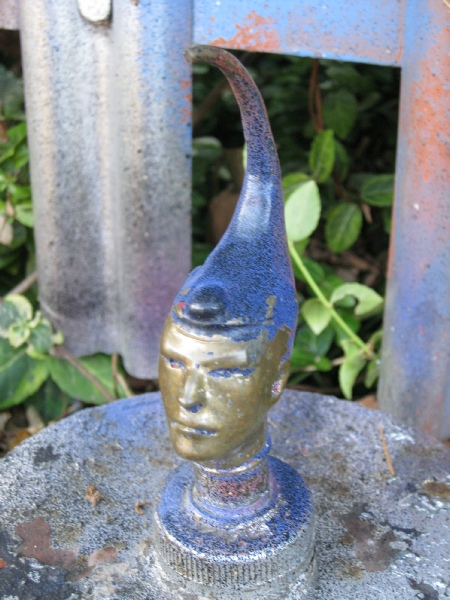
It is impossible to miss the bulk of the old CHN factory, but easy to overlook a series of tiny sculptures on the towpath wall right opposite. They are by Jonesy, a bronze sculptor who works from a studio in Tower Hamlets. His miniature works may also be seen on the Regents Canal and in other parts of the East End too. The artist’s bronze works sometimes allude to environmental causes - fracking being a particular target - but often just seem rather haunting in their own right. In any event the sculptures are always intriguing and thought provoking although many, like 1, have have long disappeared.
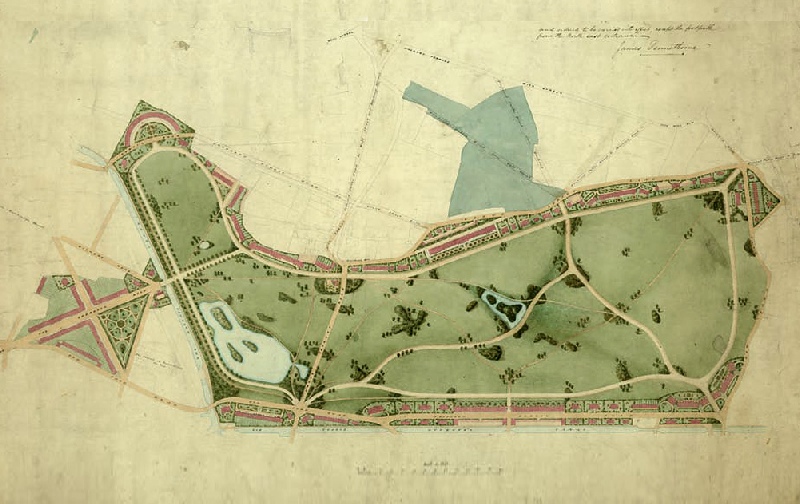
Walking on a little further will take you under Skew Bridge, so called because that is exactly what it is - a bridge that carries Old Ford Road obliquely across the canal and is shown on James Pennethorne’s original map of the park (2). Initially there was a second cistern lock here, but it was a single, not a double. Passing under Skew Bridge will bring you to the boundary of ‘Vicky’ park. This, eastern, part was once home to the local Lido, an outdoor pool which, sadly, was demolished over thirty years ago. The Forum (or For ‘em and Agin ‘em as it was sometimes known), a kind of East End Speaker’s Corner, was also located in this area but has long fallen into disuse.
Initially, the standard width of the Hertford Union towpath was 10 feet and along much of canal the boundary was marked by a low brick wall. However, the towpath has long been separated from Victoria Park by railings, which are of quite some vintage, and there is a disused gate which allowed direct access from the canal. The gate and the railings clearly escaped the large scale metal collections that took place in the early years of the Second World War, when there was a great drive to turn scrap iron into munitions. At first the surrender of railings which, according to recycling experts, had a special value in the manufacture of ships’ cables, chains and other fittings, was voluntary and many London boroughs offered those in public ownership. Some commentators applauded this. The influential left-wing writer and broadcaster J.B. Priestly, for example, considered railings as ugly thickets of iron, observing that London parks had miles of railings around them. He also complained about The little gardens in the squares, which might be open and pleasant, are severely railed in, as if there were tigers lurking in their bushes.
Tigers or not compulsion soon arrived. As the need for scrap metal grew requisitioning became necessary and in October 1941 many local newspapers informed their readers that unless railings were needed for safety reasons or had special artistic merit or of historic interest then they could be legally taken away. Passions ran high about the change and the Daily Mirror had a report about one irate owner marching into the office of a borough surveyor, slamming down a pistol and exclaiming ‘That is for the bloke who is going to take my railings’. I think we can safely say he lost his railings anyway.
The canal side railings of Victoria Park were clearly needed for safety reasons even if they were not regarded as having artistic or historic interest and so survived. They were cut by neither oxy-acetylene torch nor hacksaw but over the post-war years many were gradually divided and, at some points, actually encased by trees and even though some of the trees have been cut down the struggle between nature and fabricated iron clearly goes on. Where repairs or replacement of the old railings has taken place the original spear head or sharp-point tops have been replaced by modern flat tops, for which anyone who has tried to climb over them is no doubt grateful.
Although Skew Bridge has, of necessity, been strengthened over the years and must bear little resemblance to the original construction, the next on the line, the Three Colts Bridge, is a scheduled ancient monument. At this point I think we pass into one of the most tranquil parts of
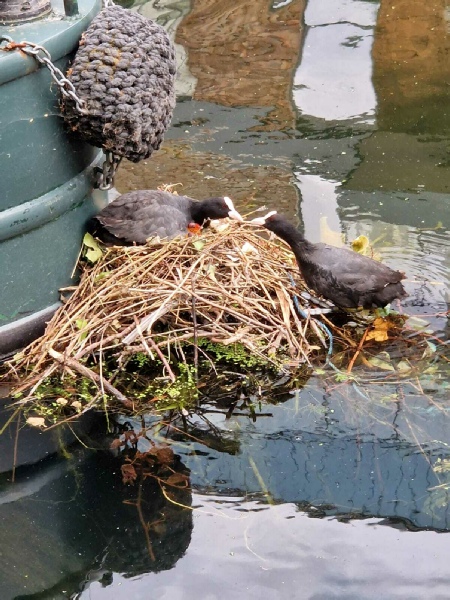
the Cut from where it is possible to observe more closely the life of the variety of birds that live by or on the canal. Coots are usually in residence, building their nests, which can be quite substantial, from aquatic material carried by beak. Passing by recently I saw a pair feeding a brood of tiny cootlings that must have hatched no more than a day or so previously (3). The cootlings would soon begin to swim and dive, so starting their own eternal hunt for sustenance. A little later they would begin to fly, becoming airborne after what looks like a running start on the water surface on feet that appear too big!
Our path will now take us over Three Colts Bridge by the side of which there is a pleasant and well tended community garden hosting a variety of herbs and flowers. There is a small bench there too so if you have walked all the way from Paddington and would like to rest this is a good place to stop. Access to the bridge is via the path which leads up from the towpath. The bridge dates from 1830, the year when the waterway was opened. It was one of seven fixed bridges (there was a swing bridge too) and a plaque on one wall is itself something of an historical artefact as it was installed during the period when the Liberal Democrats were in power in Tower Hamlets. During those eight years, between 1986 and 1994, the borough was divided into seven Neighbourhoods. One was Bow, which developed its own heritage trail.
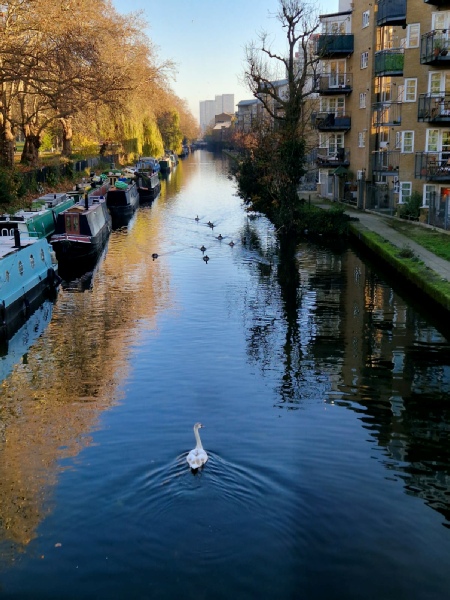
The elegant central metal deck of Three Colts Bridge, which now carries foot and pedal power traffic to the park from Gunmakers Lane, was probably brought to the works in pieces and then assembled on site. If you are interested in this kind of thing look over the side when you are on the bridge and you may see the nuts used when bolting on the parapet. Or, if you have time to stand and stare you will be able to observe the canal in either direction and have a birdseye view of goings on in the waterbird world (4).
One small enterprise that was apparently swept away when the Cut was developed was the Three Colts Tea Garden. All tea gardens in the area would have been an easy walk from the more developed parts of east London such as Spitalfields and their loss to encroaching industrialisation keenly felt. But young people need somewhere to go and enjoy themselves and Victoria Park would have been some compensation. It still is. In the 70s and 80s free music events with a political base (building on a tradition of demonstrations in the park and other radical East End movements) such as the 1978 Anti-Nazi League or the 1985 Jumping and Jiving for Jobs concerts took place here. Now commercial concerts dominate the scene, or at least they did until Covid struck. As was the case with municipal parks all over the country the revenue raised from commercial use helped maintain the facility at a time of increasing financial pressure. Nonetheless, such use irritated some local families and young single people, particularly those without access to a garden, who lost access to a substantial part of the park over an extended period after the perimeter hoarding went up. The increased use of the park during the Covid-19 pandemic underscored what a valuable resource was left to us by the Victorians but it would appear there will be no return to allowing full use of the park by everybody all through the year. Indeed, it is possible the number of days the park will be used for commercial festivals may increase.
It is possible to leave the bridge and go back to the towpath and then walk along to the next lock. However, our route means we cross the bridge and turn immediately left and walk to the path that runs by the side of the canal. Turn right there and start walking and you will get a view of the Cut which is different from that offered from the towpath. In all seasons it is a good place to watch birds on the water - or ice (5).
Hertford Union Canal
This page 2 of 5
When London Became An Island

5
4
3
2
1