When Mr Statham returned to Wharf Road after missing the boat at Orfordness he would have wanted to know, as soon as possible, if laying the cable to Holland had been successful. Once the good news arrived congratulations were no doubt offered by the Gutta Percha Company directors and the workforce too. For those on the factory floor, producing many items for domestic, sports and gold rush use along with miscellaneous tubes and cores manufactured for submarine and subterranean telegraph projects, success in projects like this offered increased security. That meant steady work, which in turn raised the possibility of putting a small portion of a hard earned week’s wages into a savings bank account. The 1850s was the decade in which Samuel Smiles published Self Help, with illustrations of character and conduct, the best selling self improvement handbook that encouraged hard work, perseverance and thrift. The capitalist, Smiles was to write, is merely a man who does not spend all that is earned by work.
The workforce at 18 Wharf Road amounted to over 300 ‘hands’ all of whom worked a six day week and who would have lived within walking distance of the factory gates. Much of the work they did would certainly have seemed monotonous but perhaps there was the possibility of learning several of skills. On the site itself three boiler houses were lodged below ground level as was a machine shop. Above these were a number of separate rooms used for slicing blocks and then cleaning, kneading and rolling the material during processing. There were a variety of other dedicated areas too, either within the main building or close by, which included a room where telegraph wires were coated, a warehouse used for block storage, a place where picture frames were produced and a carpenters’ workshop. This would have meant there were piles of newly produced objects in many places including, perhaps, on the basin landing stage. There extensive lengths of cable core might be seen loaded on tied up boats. These were being made ready for testing, which required immersion in water.
The Wharf Road area was certainly busy although the only other large factory on Wenlock Basin was the London Zinc Works (or Mills). It appears that soon after the basin was opened zinc processing began at the waterside site and in 1837 an application was made by a Mr Steinkeller for a patent concerning plates or tiles for use on roofs or other parts of buildings. The works were owned by the Rothschilds, probably through a bank established in London in 1809 by Nathan Mayer Rothschild. The Rothschild family had considerable interests in refining minerals in several parts of Europe and the bank was held in high regard by the British government as it had not only facilitated the payment of the Duke of Wellington’s armies in the Napoleonic Wars but had once provided backing to prevent collapse of the Bank of England. A few months before the Duke passed away the bank, by then called N M Rothschild and Sons, obtained a lease to refine bullion imported in to the United Kingdom, a contract that it was to keep for over a century.
Most of the other enterprises in Wenlock Basin had nothing like the capital resources of the main two. They were small businesses involved in the metal, stone, timber and coal trades with frontages on Wenlock and Wharf roads. All of their premises backed on to the basin and maintained their own facilities for loading and unloading boats. Canal transport remained an economic option for transporting bulky material around north London and beyond, as had been anticipated in the canal company prospectus over 40 years previously. Some enterprises on the Regents brought raw material in by boat and sent most of the finished product away by the same means. However, other firms distributed much of what had been manufactured by road and therefore had their own stables because horse power, despite the best efforts of Walter Hancock, was still the prime method of transporting people through the streets and that held true for goods too. Rhode’s Bridge had been constructed at the end of Wharf Road more than twenty years previously and this would have given easy access to traders from both City Road and Wenlock basins seeking to meet the needs of residents of housing developments built on and beyond the north bank of the canal.
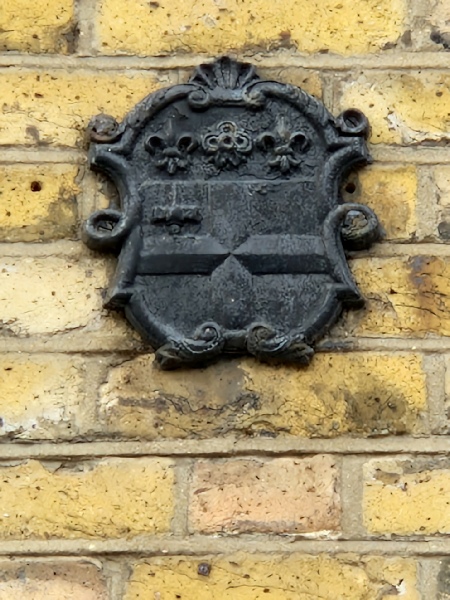
Like several, but not all, businesses on Wenlock Basin the gutta percha and zinc factories were insured and may have had fire marks on their facades to indicate the company, or companies, providing cover. The photo to the right shows a fire mark that still remains on 357 Mile End Road, hard by Mile End Bridge. The insurance industry was well developed by the 1850s, the danger of fire in the crowded, part-residential part-industrial suburbs of the expanding capital being ever present. Conflagration was such a matter of concern that a Royal Society for the Protection of Life from Fire had been established in 1836 and a Mr Baddeley, who was an inspector for that organisation, lived not far from Wenlock Basin. The Society maintained a number of escape ladders on wheels, under the supervision of a conductor. These could be pushed to a burning building allowing those trapped above ground level to be rescued and giving firemen access to windows on upper stories. The wheeled ladders had been designed by Abraham Wivell, the owner of a society hairdressing salon and a fine portrait painter, whose innovation certainly improved the chances of surviving a fire in a domestic building. A contemporary illustration showed Wivell in the working clothes of a fireman as he reached the top of a ladder with axe in hand.
Destructive fires had been a threat to London from the time it had been called Londinium but although the Great Fire of London of 1666 had prompted some building restrictions and, eventually, a fire fighting capacity supposedly maintained by local parishes, the provision of facilities remained somewhat haphazard until the 1830s. Many fires began in houses where for most people there was no alternative to an open coal fire for warmth and cooking. However, even as gas became available some extolled the virtue of the old ways particularly if they were writing for the well heeled who had servants to lay fires and clear up afterwards. Take this item from the Glasgow Gazette in October 1852 which was extracted from a letter in the Spectator.
Gas in many cases may supply the place of fuel; but it would be absurd to dictate to all persons that they should use a fire which did not please their sensations. The truth is, that an open fire is agreeable in many ways: it produces ventilation; it gives radiant heat to the feet, and thus acts as a force-pump to cause the blood to circulate when impeded by pressure on the veins and arteries in a sitting posture. And although the fire doubtless produces dust, there is one sensation it gives, pleasant to all: the flickering flame is like running water – it is life; and the changing form of the fuel is analogous to the pebbles in running brooks.
Although the open grate of a fire was of little danger in itself when clothing, particularly dresses, brushed too closely to the burning coals disaster could quickly follow. Even the single flame of a carelessly handled candle could start a fire that it was impossible for a householder to put out, so bringing catastrophic consequences.
One such fire occurred in early June in Denmark Terrace, a street that lay almost over the Islington tunnel. When fires broke out members of the public were urged to contact the conductor of the nearest Wivell ladder but in this case it seems there was a delay, although six people, all in an exhausted state, were rescued from the second floor after an ordinary ladder was found. The rescue did not stop the fire spreading of course and by the time Mr Baddeley arrived the ground floor, which was used as a grocer’s shop, and the first floor were ablaze and adjoining premises were in danger of being burnt out too. When the inspector learnt there was a child still in the building the Wivell was raised but when the conductor attempted to enter on the second floor he was driven back by the heat and smoke. Another attempt was then made by a police sergeant who rushed into the building and ran up the stairs pursued by the flames. Unfortunately, this attempt also failed and the sergeant, by this time burnt on the face, had himself to be rescued from a windowsill. A third attempt to save the child could not be made so there was nothing to do but wait until a fire engine arrived and put the fire out. This was not achieved until the roof had fallen in and all the shop stock and furniture had been consumed in the conflagration. It was only afterwards, when the fire was finally extinguished that a search could be made for the child. His body was found on the second floor and while it was unclear if he had died as a result of smoke inhalation or heat he was terribly disfigured. When the death of the boy was officially reviewed the coroner commented that the tragedy may have been avoided if the conductor had been contacted earlier.
Out of control fires started in industrial premises too, particularly in those which processed combustible materials. Moreover, as international trade grew so more and more warehouses were needed, particularly on the banks of the Thames. Attempts to control the size of the largest, sometimes described as Manchester warehouses, were thwarted by owners who insisted that their buildings were not actually warehouses but just places where large shipments were broken into smaller units. Despite misgivings that it would be impossible to extinguish a fire if it caught hold and that it could soon threaten residences close by, a number were built and allowed to operate. Although there were no such monsters by the side of the Regents, streets close to the canal and its basins, particularly between City Road and Limehouse, faced increased fire risk as enterprises such as saw mills and gas works were established.
If a warehouse or factory was damaged by fire then, should an insurance policy be in place, much of the financial loss would be carried by the insurer. Since it was clearly in the interests of both the property owner and the insurer that fires be extinguished as soon as possible a number of insurance companies began to maintain their own firefighting teams, some of which were equipped with horse drawn fire engines that could project a piston driven jet of water. These pistons were connected to levers that had to be worked up and down in a see-saw motion to create the required pressure. The photo to the right shows a late C18th engine from the Wiltshire town of Trowbridge, which was an important centre for the production of woollen cloth on the Kennet and Avon Canal, part of the waterway link between London and Bristol. The town had its share of fires and as production of an extinguishing jet of water from the engine needed the levers to be operated it was not unusual for bystanders to help out. The work could last for some time and be exhausting so in larger towns and in cities this might be paid for by the hour.
In the first decades of the C19th the provision for fire fighting in London lay with approximately three hundred fire engines that were in the hands of a local parish, plus a few private engines and those owned by the insurance companies. Many appear to have been poorly maintained and as there were no properly trained firemen they were often not used efficiently. The consequence was an increasing number of fires causing spiralling financial losses and a rising death toll. In 1829 fires at three warehouses used for the West India trade had estimated losses of £300,000 (multiply that number by 140 and you have a rough estimate of the value today). In September 1830 alone, according to the Morning Herald, there were 29 fires recorded in London and there must have been many more that went unrecorded because they were extinguished by stamping or thrown water before they got out of hand. However, even the figure published in the Morning Herald was almost certainly wide of the mark as there was no systematic way of collecting and recording the information. It was in this context that a number of insurance companies decided to pool their resources and in 1833 a formal London Fire Establishment was created. This clearly needed someone of proven ability to lead it and the obvious choice was James Braidwood, who was at that point in command of the Edinburgh fire brigade.
James Braidwood had taken charge of the Edinburgh service when in his early 20s and had proved to be a remarkable leader and a first class organiser. His coolness and courage in dangerous situations were noted from the very start. On one occasion, for example, he went into a burning building to find and bring out a cask of gunpowder before returning to collect another. Although insisting on tight discipline in the brigade he took a sustained interest in the wellbeing of his firefighters for he understood how traumatic execution of their duties could be. Everyone knew he could speak and instruct from his own experience and in any major conflagration he would be on the front line directing operations. It is not surprising that when Braidwood was offered and accepted the post of Superintendent of the London Fire Establishment many in Edinburgh felt sorry to see him go.
After moving to London Braidwood began to radically improve the way in which firefighting in the capital was organised. Central London and the City were divided into four districts. A,B and C were north of the River Thames and and D to the south. District A was, approximately, to the east of St Paul’s Cathedral, B lay between St Paul’s and Tottenham Court Road and C was to the west of B. D covered the south bank of the river. The Establishment headquarters was in Watling Street, not far from St Paul’s Cathedral, where Braidwood and his family also lived. Fire stations were established in all four districts and this was where fire fighting equipment and engines were kept. A new fire engine was eventually approved by Braidwood which, although it worked on the same principle as the Trowbridge engine, was designed specifically for London streets. Attention was given to the most minute detail of which tools and implements were to be carried and what manufacturing and maintenance standards were to be met. A thoroughgoing process was also demanded for what was essentially a new body of firefighters, young and fit men ready to accept a high standard of training and discipline in return for what was regarded as quite a good level of pay. Any of the ‘old guard’ inherited from pre-Establishment days who proved unwilling or unable to meet the new standards were pensioned off. As time went by Braidwood’s published writings on fire prevention and extinguishing were well read and it is no surprise his advice was constantly sought by commercial companies and municipal authorities alike.
Insurance and fire brigades were all well and good but, nonetheless, owners of factories in particularly vulnerable places were well aware of how they could quickly be ruined by all consuming flames. Consequently, efforts were made by many to ensure their properties were at least fire resistant, something that Braidwood encouraged. Good planning meant adequate safety measures could be incorporated into the design of a manufacturing base. As far as the Gutta Percha Company factory was concerned the walls were built of brick and internal iron doors were fitted to stop, or at least slow, a fire spreading. It is not, however, clear if a regular appraisal of fire risk was made and although some companies actually kept their own fire engine on site this was not the case at the gutta percha factory. However, by the 1850s it must have been anticipated that a fire engine could turn up very quickly to help contain any outbreak around City Road or Wenlock basins because there was a London Fire Engine Establishment base reasonably close at Whitecross Street and engines from other bases would always lend support if needed. As far as insurance was concerned few insurance companies would have been prepared to take on the whole risk of a sizeable factory like that of the Gutta Percha Company and from the point of view Bewley and his partners it was clearly better to spread premiums between a variety of companies in case one went bankrupt. Consequently, policies were taken out with a number including the Imperial, Scottish Union, Royal Liverpool, Sun and Yorkshire.
Given that, under the direction of Braidwood, the Fire Establishment had greatly reduced the number of fires that resulted in a complete burn out and that the site was properly insured, Mr Statham must have felt that the factory and business was a safe as it could reasonably be made. With the success of the Orfordness to Scheveningen connection the priority now was to focus on the future and obtain more work in the ever expanding development of submarine cable, the great contemporary ambition being to produce and lay a cable to span the Atlantic Ocean.

When London Became An Island
Gutta Percha comes to the Metropolis
Chapter 16 - Insurance is so important
Commanders and clippers


Trowbridge fire engine
A fire mark
Abraham Wivell