Although in many ways long distant transportation by canal was far superior to land carriage there were drawbacks, one being the time lost in moving from one level to another through a lock. Bottlenecks could occur and crews leaving Limehouse Basin for the Midlands might have had to wait for access to twelve locks before reaching the top pound and the Grand Junction. There could be added waiting time at Islington too because as the canal tunnel had no towpath boats had to be ‘legged’ through, a process contemporaneously estimated to take approximately 15 minutes. As the tunnel required monitoring to allow the smooth operation of two way traffic supervisors were employed at each entrance and small huts were built for them. In 1826, in order to speed things up, a small 4 hp steam tug was installed that, linked to a chain, went backwards and forwards pulling barges along.
Given the pressure bargees were under to deliver their cargoes in good time it is not surprising problems occurred if more than one boat was intent on leaving the precincts of London at the same moment. One Tuesday evening in August 1827 three barges, bound for Birmingham arrived at a lock reported as being ‘at Maiden Lane’. This must have been St Pancras Lock as it was the one nearest to that road. It would seem all three boats, which had presumably been tugged through the tunnel together and, having passed Kings Cross Basin and the Imperial Gas Works on the south bank, were intent on getting through the lock first. Unfortunately, in their haste, the towrope of one boat somehow caught fast on another, called the Vittoria, and made it unstable. Any attempt to dislodge the rope must have failed because very quickly the Vittoria turned over and sank taking the helmsman down with it.
The first action of those on the boats was to try and rescue the helmsman. They succeeded in this although the man was both unconscious and seriously injured. The next step was to try and salvage as much of the cargo as possible. Had the Vittoria being carrying coal little or no damage would have been done as it fell into the water but this boat was due to deliver consignments of East Indies sugar, tea, rice and wine and most exotic of all Spanish goat skins.
Newspapers all over the United Kingdom, from the ‘Cheltenham Advertiser and Gloucestershire Fashionable Weekly Gazette’ to the ‘Drogheda Journal or Meath and Louth Advertiser’ reported the accident and all mentioned that the sugar the Vittoria was carrying was from the East Indies, which today we might call the Indo-Pacific region. The term 'East Indies sugar' was significant in the political climate of the time. Although British involvement in the slave trade had been officially terminated in 1807 slavery itself was legal in British dominions in the West Indies and these were a major source of sugar production. This commodity was singled out by abolitionists who encouraged the consumption of East Indies sugar as it was not produced by slave labour. Consequently, a journalist might show their sympathies through emphasis in their articles and the distinction made in the press between West and East Indies sugar helped support the abolitionist cause. Slavery was not finally made illegal in British controlled islands in the West Indies until legislation was passed at Westminster in 1833.
It is not clear where the rice came from but if it was from India then it might be expected it would have been called East Indies rice to distinguish it from American rice. Rice termed American on the British market actually came from the United States and was produced in Georgia and the Carolinas, both of which were slave states. However, as the United States had shed British control over forty years previously the parliament in London held no sway there. Consequently, although the British abolitionists may have disapproved of the import of American rice, they focused their resources elsewhere and targeted sugar above all else.
The goat skins imported from Spain were probably a reflection of changing attitudes and progressive legislation too, although this was to do with economic rather than humanitarian factors. At the start of the C19th few industries were as intensely regulated as that producing leather but over the next quarter of a century, under the influence of the economic theories of David Ricardo, many restrictions were jettisoned. This relaxation helped spur factory expansion, particularly in northern towns, which was partly driven by reduced retail prices. One advert of February 1827 read Behold! In view of the duty being taken off leather E.Vandervelde is able to reduce the price of his Wellington Boots. The more fashionable end of what we might call the ‘Ladies market’ developed too and kid gloves, which were often made from goatskin, were usually mentioned in monthly fashion advice to well heeled women. The goat skins on the Vittoria may well have been on their way to be turned into light, soft and strong gloves for delicate hands.
Wherever the goods being transported had originated (the tea certainly came from China) the sight of such a valuable cargo sinking to the muddy bottom of the canal would have immediately prompted someone to try and contact both officers of the Regents Canal Company and Crawley, Hickland and Co, the firm that owned the Vittoria. Both were located at City Road Basin. As there was no towpath through the tunnel urgent appeals for help may have had to be rushed by road, perhaps carried by an agitated horseman or maybe by a boy or girl running pell-mell in the hope of being rewarded with a penny or two. However, it is possible that a fleet footed messenger may have taken a short cut and after heading to the tunnel and breathlessly blurting out their baleful news, the chain boat operator told them to jump into the tug and hold on tight for full steam ahead.
The sinking of the Vittoria took place at about 6 pm and by the time an hour had gone by there must have been a great deal of action and perhaps panic on both sides of Islington Hill. Initial responsibility for sorting the crisis out would likely have fallen on the shoulders of Edmund Snee, designated the company clerk but essentially the company secretary. He was a key figure in the organisation and would have certainly abandoned any idea of enjoying a pleasant summer’s evening as he rapidly thought through the consequences of a sunken boat blocking movement on the Limehouse to Paddington link. Imperturbable as he usually appears to have been he would have known time was of the essence for when reports of the sinking rippled up and down the canal, boats came to a halt as horses and men waited to hear what to do next. Then, as news spread beyond the towpath, others affected must have begun to wonder what it would mean for them. Like the barge crews, those who helped keep the canal network operational by meeting the needs of passing boats were often in a rather precarious financial position, so a casual worker who helped muck out the stables and look after the horses might fret over the stoppage and become apprehensive about how much out of pocket they might eventually be. The owners of the Vittoria were in an even worse position. As it was usually the case that two names linked in the title of a company indicated the existence of a partnership there would have been a Mr Crawley and a Mr Hickland who might now be looking at complete financial ruin. It all depended on how much could be salvaged. Before six o’clock their fortune had been in the hands of the unfortunate helmsman but by seven it lay with officers of a canal company that had its own financial problems.
By the middle of 1827 the Regents Canal Company was well in arrears in repaying a loan that had been provided by the government to enable the project to be completed. Interest was being charged on the outstanding capital and as this amounted to over £10,000 the total debt was more than £200,000. The last thing needed was an unplanned stoppage that would cause an indefinite suspension of toll income collection and disrupt delivery schedules. In these circumstances it is hard to fault the action taken by the company, which was started as speedily as possible. Who actually took the final decision is unclear but it is possible the chosen option was suggested Mr Snee. Snee had been employed by the company in an administrative capacity for over fifteen years and probably knew more about the day to day running of the canal than anyone else. He was almost certainly on site and would have sent an urgent message to Colonel Drinkwater or another senior member of the canal committee intimating what he thought should be done. A rough night for many then followed. These included Mr Snee, bargees stuck between locks with a horse that needed fodder and resting, the owners of the Vittoria, the family of the helmsman and lock keepers all the way down to Limehouse who were told to open the gates and let all the precious water beyond St Pancras Lock flow into the Thames. It was only a year since a similar sudden fall in the water level had occurred but that was when a stank between the canal and Wenlock Basin, which was still under construction, had collapsed allowing water to pour in. The amount of water lost in that event was, however, far less serious than after the disaster near Maiden Lane.
Although the level of the canal below St Pancras Lock soon began to fall it probably seemed an age to those with a vested interest in the Vittoria before the water was effectually cleared. Then, at last, at about 5 am, early morning light allowed lanterns to be extinguished as the true scale of the disaster could be revealed.
Chinese tea leaves, which must have been carefully plucked and packed before being brought to England by the monopolistic East India Company, would surrender their taste to pure hot water but not to murky puddles. A ship from a port in India would have brought the Bengal sugar that had turned into a coagulated mess on the canal bed and, although the rice may well have been imported from the United States rather than the East Indies, fish would now be the only consumers. Both the wine and the goatskins were ruined too as were upward of 20,000 newspaper stamps for the ‘Sheffield Mercury’. At that time every newspaper had to pay a tax through a stamp, which was actually an impression on the paper the news was printed on. The tax generated considerable revenue for the government and as each stamp impression cost 4 pence and there were 240 pence to the pound the amount paid in tax by the proprietors of the ‘Sheffield Mercury’ for the spoilt consignment would have been over £300. This was a considerable sum. The greater portion of the sale price of any regular newspaper was the tax but it is unclear if the heart of the relevant authority was softened on hearing about the loss of the Vittoria and authorised new stamps to be issued free of charge. It seems most unlikely however.
By 6 am everyone who had inspected the Vittoria must have seen that yesterday’s cargo was a complete write off although there might be a little value in salvage. The Vittoria itself could be righted and refloated but the value of the lost goods was estimated at £2000 (some newspapers stated £9000, but that was probably a copied typographical error) which in today’s money equates to around £270,000. Whether insurance had been take out or not is unclear but with the canal bed to the east of St Pancras Lock now dryish immediate attention was given clearing the ruined goods so the waterway could be reopened as soon as possible. However, it was soon observed that the salvage site was attracting unwelcome visitors in the form of ‘a number of known depredators’ and so many turned up that the constabulary were called in. Led by two, named Cadby and Coulton, the ‘nefarious attempts’ of thieves and pilferers were consequently frustrated. One person no-one from the Regents Canal Company wanted to see was Counsellor Agar but although the accident had taken place right by the lawyer’s property it seems he did not appear. This was fortunate for had he done so it may well have been to see if he could make some kind of spurious claim for compensation.
By late Wednesday afternoon, if the question of a replenishment payment had been settled with the Grand Junction and if there was enough water in the reservoirs to ensure navigation on that canal would not suffer, the pounds to the east of St Pancras Lock could have gradually started to be refilled and barges may have started moving again. The Vittoria, now buoyant, could be towed back to City Road Basin steered by a replacement helmsman and passing through the tunnel where pressure in the steam boiler had been raised in anticipation of operations restarting.
Although events at St Pancras Lock were a disaster for the owners of the Vittoria it would appear the quick action of company staff may have least boosted the confidence of subscribers in the way the canal was being run. Perhaps some now saw light at the end of their tunnel. Shares bought in anticipation of a regular income had proved totally disappointing but when, in October, a new tranche was offered in order to clear the government debt they were taken up. Despite having to wait two more years for payment of a maiden dividend some of the initial subscribers may have convinced themselves they had been right, after studying the prospectus, to have invested in the Regents Canal Company but whether Mr Crawley and Mr Hickland regretted opening a base at City Road Basin I do not know.
Back to Camden to Kings Cross 2

Commanders and clippers
When London Became An Island
The Sinking of the Vittoria
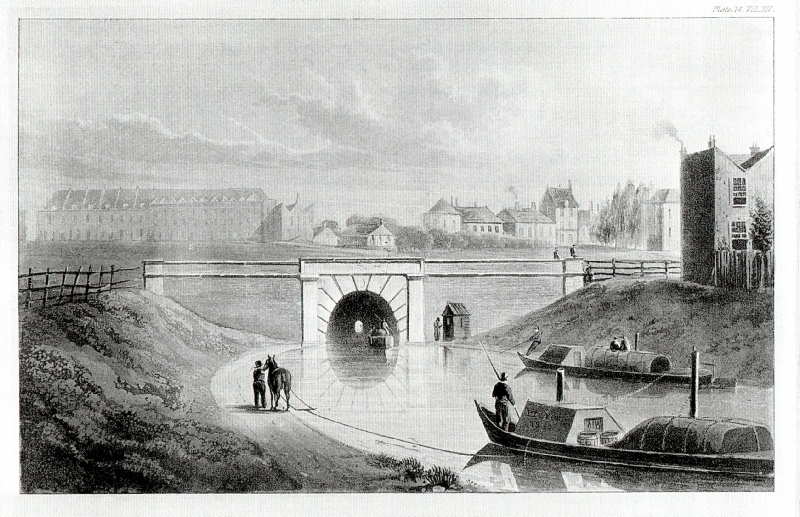
Western entrance of the Islington tunnel soon after opening
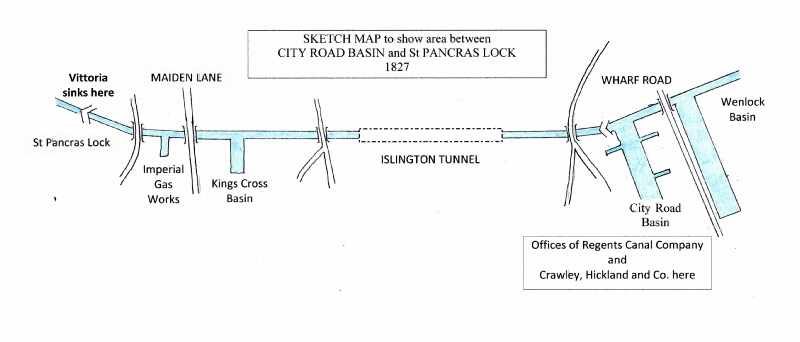
Sketch Map