The day after the calamity at the gutta percha factory should have been the start of the working week but many wage earners must have realised they might now be facing destitution. Some employees had had the foresight to build up a ‘rainy day’ fund in an on-site savings bank but no-one could know if their accumulations would last until the factory re-opened or, indeed, if that would be possible anyway. All the unemployed could do was watch as assessments began to be made of the damage and hope for the best. For men with family responsibilities the desperation was that much more acute.
On Monday morning, mixing with those workers directly affected by the disaster, were others who were just sightseers. So many of these arrived that, once again, a substantial number of policemen had to be deployed to keep order. Threading their way through the crowds would have been directors of the gutta percha company, those responsible for the zinc mills and the anxious owners of smaller enterprises too. One of the first things that needed to be done was to work out how all the debris and damaged fabric could be removed from the various premises around the basin. It is an ill wind that blows nobody any good and no doubt some carriers would have been making their way to Wharf and Wenlock roads to work out estimates for this work and for then bringing in material for repair and rebuilding. There would also have been various officials including Superintendent Braidwood, who was obliged to promptly give an outline of the damage to the Establishment committee. Representatives of the insurance companies sat on this body and would want to know what proportion of the losses would fall on their respective employers. The Superintendent’s initial report, which must have been started late on Sunday night, stated that the greater part of the gutta percha factory had been burnt down and that included the upper floors of the engineers’ and mechanics’ shops. In the initial stages of the fire attempts had been made to save these areas as they were upwind of the blaze so this comment would indicate the efforts failed, although at least one newspaper reported the adjacent warehouse and the wire covering department survived. Nonetheless, the roof of the factory was gone, the lower part was damaged by both fire and water and the two boats from which the telegraph cable core had been jettisoned had been burned too. Interestingly, Braidwood said a very considerable quantity of the electric telegraph wire had been saved and without the slightest injury so, although some press accounts said it had all been destroyed, I think we can take it that the cable core was in fact recovered from the depths of the basin. The committee members would obviously have been interested to see which insurance companies would be making the most substantial payments, particularly as some newspapers were making wild guesses as to the total losses. One suggested these could be as low as £20,000, another over five times greater and others in between. Whatever the speculation, Braidwood’s report indicated the factory was insured with the Imperial, Scottish Union, Royal Insurance and Yorkshire fire offices and although this list differs from the companies cited in the press, no doubt the Superintendent was absolutely clear before putting pen to paper.
A number of London based newspapers which, on June 6th, carried dramatic accounts of the gutta percha fire included Braidwood’s comments about the affected properties. He found that, compared with the gutta percha site, the zinc factory appeared to have had only slight fire damage to the back gates, window frames and roof. Some glass had been broken too, but the main injury to the property had been as a result of many tons of water flooding into the machine pits. Still, at least the factory was insured, although with only one company, the Sun. Of the smaller enterprises affected only Mr Gorton’s business, adjacent to the gutta percha factory, was definitely insured, this time through the Hand-in-Hand and County fire offices. The report did not mention anything had been thrown into the basin from the firewood factory but Braidwood said a great quantity of wood had been burnt, so some piles must have caught fire even as those fighting the blaze tried to save both the premises and the building next door. At least the structure of Mr Gorton’s property, except for slight damage to the stable roof and some windows, escaped unscathed.
Of the other four affected enterprises, that of the Patent Cooperage Company seems to have suffered most. There the storehouse was burnt out, the roof had collapsed and the timber stock partially burnt. Nearby, Harpers and Moore, a firm manufacturing firebricks and tiles, saw some fire and water damage to its stock along with damaged back gates, broken glass and burned out window frames. A similar situation was observed at Mr Pagdon’s iron foundry, which also had a damaged roof, whilst a nearby coal merchant, Thomas Hanson, would need to spend time and money on repairs both to his stables and two barges that suffered scorching as they lay in the basin.
That the losses to these smaller concerns was not nearly as bad as it could have been was a tribute to the work and determination of the brigade men who spent long, hot hours directing jets of water into what was regarded as one of the most rapidly spreading fires seen in London for many years. Without their efforts and the careful deployment of all the attending engines by Braidwood the report to the committee would almost certainly have indicated the greater part of all the smaller properties and the zinc works too had met the same fate as the gutta percha factory. It has to be said that good luck also played a part for the New River Company was able to provide all the water that was needed. Some water companies operating in London did not offer such good service.
Despite its importance, not all references to gutta percha in London newspapers distributed on that Monday were linked to the Wharf Road fire. The Patriot, a journal only published twice a week and mostly offering articles relating to religious and parliamentary matters rather than the spice of everyday life carried an advert aimed at those emigrating to Australia, particularly anyone considering trying their luck in the search for gold. A ‘rush’ had begun in 1851, exploration and exploitation being supported in London by the creation of companies such as the Colonial Gold Company, which issued a prospectus in March 1852. This document stated one objective of the enterprise was The working of gold and silver mines and alluvial deposits of gold in the best parts of Australia in a systematic manner. An illustration included in The Patriot advert showed a potential ‘digger’ cutting up sheets of gutta percha to line his box. Spare soles were on the floor next to boots and shoes and several useful containers were ready to be packed. On the wall a poster indicated the disembarkation port of this optimist. However, as he had also bought a life buoy, he must have realised a long journey by sea was not without hazard.
There appears to have been no other British company manufacturing gutta percha utensils specifically for Australia bound ‘gold rushers’ in this period and so, as the The Patriot advert warned that it was difficult to find a shoemaker in Australia, we can imagine the discomfiture when news spread that the Wharf Road factory had gone up in flames. According to the Thursday edition of The Patriot there were a number of people just about to set sail to New South Wales. Unfortunately for them there would have been no point in travelling to Wenlock Basin to see if any soles had survived because, so the Morning Herald reported, out of an immense number of drinking-cups, plates, fancy frames, inkstands, &., which were stored in the premises nothing can now be seen but partly consumed heaps of gutta percha … A small Islington business may have also have been immediately alarmed about the destruction of gutta percha stocks. Fyfield’s Brush and Toy Warehouse was advertising a New Registered Rocking Horse that had an extra guard and gutta percha springs that would make it perfectly safe and noiseless. Perhaps some doting parents who had ordered an improved horse as a birthday present would now have to be told their child could only be provided with one that squeaked.
One resident who lived not far from Wharf Road may have been more perturbed than most about the fire, but not because of the lack of a rocking horse. Caroline Chisholm is an important figure in the history of Australian immigration, so much so that in the late C20th her portrait appeared on an Australian bank note. Born in England she moved to Australia after her marriage to an officer in the service of the East India Company and soon began to involve herself in welfare work, particularly with young women. She returned to England in the 1840s in order to help publicise the benefits of life in Australia and to improve the whole emigration process. A blue plaque indicates she lived in Charlton Place, not far from the City Road Basin, so she may well have known the Snees, who resided in nearby Colebrooke Row. Captain Chisholm returned to Australia in 1851 but his wife did not immediately follow and she was in London in June 1853 for meetings to do with her humanitarian work. Consequently, it is quite possible that, on the morning of the 5th, she donned her bonnet on seeing excited people streaming past her window and followed them to Wharf Road.
Given the reasons behind her interests in Australia, Mrs Chisholm could well have been concerned about the consequences of the unfolding disaster for there was clearly a demand from emigrants for the products of the burning factory. However, I wonder if she reflected that the loss of the stock of gutta percha soles might encourage more shoemakers from her home town to book their passage to the antipodes as they would be more or less guaranteed a good living. She had been born (and would be buried) in Northampton, the traditional centre of shoe production in England and where, five years previously, an anti-gutta percha campaign had been launched in order to encourage shoemakers to protect their craft by joining a trade union.
As Caroline Chisholm absorbed the news of the fire and Superintendent Braidwood worked on his report those closely involved with the Gutta Percha Company would have been trying both to come to terms with the results of the calamity and to decide if the firm could continue to operate or not. Were there competitors in the field that could offer to fill the gap the fire had burnt in the supply chain? Well, there was one, based in West Ham, that was able to turn out many types of gutta percha products but almost certainly did not have the capacity to begin manufacturing cable cores. Moreover, the core produced for the Electric Telegraph Company had been saved by being submerged in the basin and Charles Hancock’s interest in the wire coating machine patent meant he would benefit if his old employer was up and running as soon as possible.
News of the fire spread out over the whole country over the next few days. By the 7th it had been carried by the electric telegraph to Dundee where compositors set an item in the Dundee, Perth and Cupar Advertiser but it was Friday before those living in John O’Groat could read about it in their local paper. By that time things had moved on although, even so, it must have been rather a surprise that even as the factory ruins were still smouldering, a notice was carried in some London newspapers stating that a calamitous fire had occurred at the Gutta Percha Company works which would occasion a temporary suspension of business but that no effort would be spared to resume working with the utmost dispatch.
The speed at which Bewley and the other directors acted can hardly be faulted but it was one thing to state an intention and another to actually get things running again although there would have been little problem in getting access to capital for such a profitable enterprise or to replace ruined raw material. The Gurney family in particular had fingers in many lucrative pies, one being the Colonial Gold Company which, at launch, had John Gurney Hoare, the nephew of Samuel Gurney, as one of its trustees. A month before the fire in Wharf Road this company had held its first annual general meeting where it was reported that over £8000 profit had been made dealing in gold dust. The company’s banker was Overend Gurney and Co. which operated under the watchful eye of Samuel Gurney himself. The Gurneys also had strong links with the Barclay family, which had interests in Barclays, Bevan and Tritton, another long established bank begun by Quakers. As for replenishing the stock of gutta percha there was plenty for auction in London with, for example, 20 tons being auctioned in Mincing Lane on Monday, a further 560 blocks on Wednesday and plenty more on its way from Singapore.
Despite the positive cash and raw material situation what could have tipped the balance against the company and caused inordinate delays, so allowing other competitors to step into the breach, would have been the total loss of the paperwork essential to the procurement, manufacturing and sales processes. Whilst the walls remained red hot and the factory floor was covered in debris it was impossible to tell if there was anything left of the sinews of business but as things became clearer it was seen that, remarkably, the company safe was still embedded, 40 feet up, in a standing wall.
Until the safe was brought down and opened it would be impossible to know if anything inside had survived in usable form. We can imagine how gingerly those tasked with rescuing the heavy metal box went about their work. They would surely have been watched by more than one company director, Mr Statham and many of the 300 hands and their families who were trusting in providence. Two types of safe were offered for sale at that time, each being manufactured with double casings of wrought iron. In the traditional, easily obtained, type the space between the cases was filled with non-combustible substances, such as pumice stone, but production of an innovative second type was jealously guarded by the original designer and manufacturer, Charles Milner of Liverpool. In a court action, also reported on June 7th, against someone who was allegedly selling unauthorised copies, an outline of the protection process of a Milner safe was made. A statement said that between the two boxes water remains permanently held in artificial vessels or in natural vessels and the very calamity brings the cure, for the heat causes the water to expand and thus it is turned to steam, and the steam moistens the substance which is to be preserved so it is an effective guard against fire.
Unfortunately, despite Milner’s reputation, things did not look promising when the heavy safe was finally at ground level for when an inspection of the outer case was made it was found the heat had been so intense some parts had melted. Given how much depended on the secured documents being preserved the tension must have been almost unbearable as the safe key was pushed into the lock. Superintendent Braidwood and Mr Statham and others closely involved in the Gutta Percha Company would have been watching closely, whilst many hundreds who were not able to see what was going on would have been listening for the reaction of those who could. Perhaps the heat had affected the lock and so it took some time to turn the key to allow the door to be slowly opened. But then, as all was revealed, there must have been gasps and shouts of joy and triumph which rippled out through the crowds. The documents had all been preserved and, according to one account, so had £5000 in currency notes! From that point on there was no question that the Wharf Road factory would not start manufacturing again, it was just a matter of time. The elation generated by this success was seen in a tribute to the value of the Milner safe signed on behalf of the Gutta Percha Company by Henry Ford Barclay, whose marriage to Richenda Gurney had further entwined the two banking families. Mr Barclay’s letter appeared in several newspapers and was printed in The Globe on Saturday, June 11th.
Perhaps some who read the testimonial went to Saddlers Wells that evening to see a performance of the Printers Dramatic Society. This was given for the benefit of the London Compositors Emigration Aid Society, established to aid compositors who could not find permanent work in England and as Mrs Chisholm very much wanted the society to succeed perhaps she was in the audience. By coincidence, an item appeared in the Newcastle Guardian and Tyne Mercury on the same day giving details of a meeting of the Family Colonisation Society, which Mrs Chisholm had founded. It was a very successful organisation and had developed a system of assisted passages. A voyage to Australia cost £20 and Mrs Chisholm had compiled a list of 600 people who could pay £5 if the society offered a loan of £15, 150 who could find £12 themselves and 300 who only needed to borrow £5. We might wonder if any of those thrown out of work as a result of the Wharf Road fire had enough money in the savings bank to take advantage of an assisted passage. Some may have come to see this as a silver lining, never returning to the Gutta Percha Company but opting instead for a life in New South Wales.
Before a year had gone by Mrs Chisholm would rejoin her husband in Australia and work amongst emigrant digger families in the gold fields. As she went from place to place maybe she noted a number of gutta percha articles in the hands, or even under the feet, of those she met and recollected they had been made in a factory not far from her old home. And perhaps, as she passed, she was seen by a digger with a London accent who put down his pick, wiped his brow and remembered that factory, served by the Regents Canal, too.

When London Became An Island
Gutta Percha comes to the Metropolis
Chapter 18 - Ruin or revival - the week after the fire
Commanders and clippers
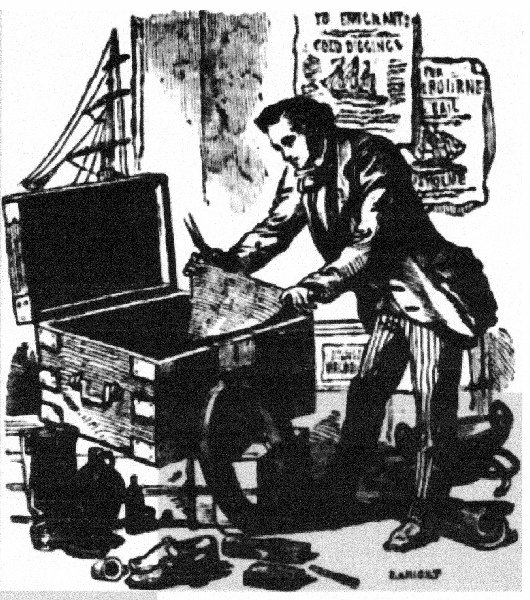
Gutta percha aids the emigrant

The testimonial
